A ROADMAP OF CRISES THROUGH 2050, AND WHAT NEVER MADE IT ON SCREEN
An hour-long podcast lays out a strikingly specific forecast for Indonesia’s economy. Compelling to watch — and worth reading with a cool head.

In the studio of The Samuel Chris Show, a man in torn trousers sits across from his host. He bought them in 2000, twenty-six years ago, and had the hole patched for ten thousand rupiah. He calls them a souvenir from a trip to America, where he once spoke with a professor in Texas about something that did not yet have a name: artificial intelligence and quantum computing. Nobody believed him then, he says. Now it is all happening.
Daud Tony arrives carrying what he describes as a vision received in 1996, and over the next hour he lays out a roadmap that is anything but abstract. It has years attached to it, figures, even coordinates on a map. This year, he says, the hardest point is not the months currently underway but October — the accumulated weight of the Iran conflict and oil prices climbing since January. Then 2027 brings a small recovery, a natural selection among those who survived 2026. Then 2028 arrives and everything sinks again, because election years always have their own way of making people sit on their money. In 2029 the economy moves once more, though for a reason he names plainly: a public festival, money handed out. And that, he argues, is precisely the problem. Too much currency in circulation, and by 2030 Indonesia begins sliding into hyperinflation.
His picture of 2030 is enough to make anyone pause. One billion rupiah held today, he says, will be worth the equivalent of a hundred million by then. The number in the passbook stays the same; what it can buy shrinks to a tenth. A minimum wage that today still supports a family on thin margins — husband working, wife at home with the children — will no longer be enough. Both parents will have to work. And the children, the host asks. There is no answer to that one.
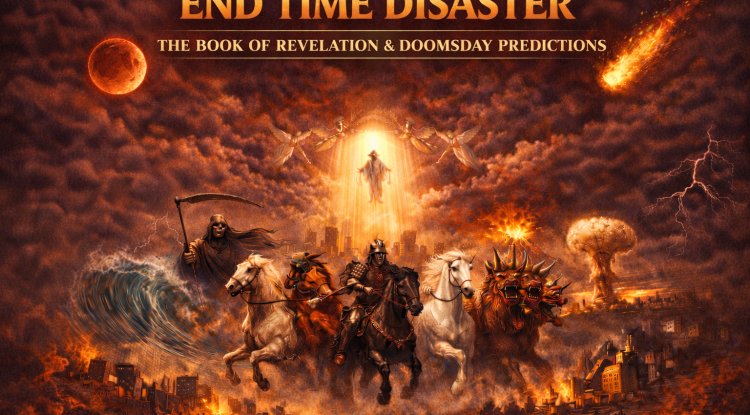
From economics the conversation moves somewhere darker. Since 1996, Daud Tony says, he has seen the world’s hackers gathered in one place in America to attack a single system while a machine studied every method they used. Out of that, he claims, the AI hacker was born. What is happening now is only a trial run. The real event waits in 2032, when quantum computing is switched on. He describes the method as an intelligence operation rather than a theft: the AI disguises itself as an application, enters the server network, works down into the central bank, spreads through commercial banking, mobile networks, laptops — and then does nothing. For two or three years it simply sits inside the system. Only once everything is under its control does the timer go off. Crypto, he says, begins winding down from that point, because the world is forced back to physical things. Gold, silver, land, certificates on paper, deeds held by a notary. He then carries this further into readings of Daniel and Revelation, including claims about who stands behind the technology — a personal belief that cannot be verified and touches sensitive ground, and is best treated as exactly that rather than as geopolitical analysis.
After 2032 comes 2035, the year he sees a water crisis beginning. His reasoning here is technically plausible: data centres worldwide need cooling, and cooling needs water. Future data centres, he says, will cluster along coastlines so seawater can be desalinated to cool the machines. We are already feeling the early edge of it, he adds — proof being that we now pay for the water we drink. In the same year he sees robots displacing human labour at scale. And in 2050, those robots no longer work for humans.
<iframe width="800" height="600" src="https://www.youtube.com/embed/A8BqNNDZ58Y?si=91dobkYRbT9MuDPB" title="YouTube video player" frameborder="0" allow="accelerometer; autoplay; clipboard-write; encrypted-media; gyroscope; picture-in-picture; web-share" referrerpolicy="strict-origin-when-cross-origin" allowfullscreen></iframe>
What is striking is that, in the middle of all this, Daud Tony refuses to join the panic over the rupiah. People are alarmed at twenty thousand to the dollar, he says, but 2026 bears no comparison to 1998. Back then the rupiah fell from around two thousand seven hundred to fifteen or sixteen thousand — a collapse of several hundred percent, alongside twenty percent interest rates and a wave of bankruptcies. Now, moving from fourteen or fifteen thousand to eighteen thousand, the shift has not yet reached fifty percent. Even the protests differ in character: they once erupted without warning, whereas today locations and permits are settled in advance. Bringing down a president, he notes, requires specific conditions to be met, and the current coalition makes that difficult. And in any case, if one fell, who would replace him — and what would change, when the whole world is struggling together.
His survival advice is conservative and, for the most part, sensible. Keep the business you already have running. Do not rush to resign, because finding new work is only getting harder. Return to the land — grow something, keep laying hens, anything that secures the stomach. Treat the recession as a chance to find where a company is quietly leaking money. And hold part of your wealth in physical gold and silver, not to chase gains but to preserve value. For the government, his proposal is almost technocratic: a single-gateway import system, where all documentation is centralised in one digital process rather than handled person by person, supervised by three agencies, with a three-month transition so industrial supply chains are not thrown into chaos, plus asset-forfeiture rules for officials involved.
This is where a reader should pause and consider what never made it on screen. Throughout the episode, the advice to buy physical gold and silver is interleaved with repeated promotion of the host’s own gold and silver shop, complete with an ordering link in the video description. That does not automatically make the advice wrong, but the conflict of interest is real and deserves to be known. More than that, the numbers do not match the narrative. Gold is forecast to rise from roughly 2.3 million rupiah per gram today to 3.25 million by 2030 — an increase of about forty-one percent over four years, or roughly nine percent annually. That is a modest, even conservative figure, and nowhere near enough to shield anyone from hyperinflation said to erode purchasing power by ninety percent. Both claims cannot be true at once.
Several details are simply wrong. The figure described as the Godfather of AI who walked away from his team because he felt he was building something harmful is Geoffrey Hinton, who left Google in 2023. He is around seventy-eight, not nearly ninety, and he is a pioneer of deep learning rather than a founder of artificial intelligence in any literal sense. The claim that European financial regulators warned a hundred and ten banks about AI-driven attacks is offered with no source at all. And the prediction that stocks would fall through May and June before recovering — celebrated as proof of accuracy — is a short-horizon call with a statistically decent chance of landing. Forecasts that miss are rarely remembered by anyone; the ones that hit get retold again and again. That bias is deeply human, and it shapes how we judge someone’s credibility more than we like to admit.
What survives all of this is the boring, long-familiar advice: keep an emergency fund, do not resign without a plan, spread assets across several baskets, and never put an entire savings account into one instrument. Gold does have a long record as a store of value, and a five to fifteen percent allocation is the range financial planners commonly suggest — not the whole account. What makes no sense is selling productive assets, draining savings, or dismantling a life plan over a picture of the year 2050.
Carrying an umbrella before the rain is wise. Stockpiling umbrellas for a storm scheduled twenty-four years from now is another story entirely.
What's Your Reaction?